Showing posts with label Christopher lee. Show all posts

Thursday, October 25, 2018

Hallowe'en Horror Quartet!!!

Annihilation (2018): adapted for the screen from the Jeff VanderMeer novel and directed by Alex Garland; starring Natalie Portman (Lena), Benedeict Wong (Lomax), Oscar Isaac (Kane), Gina Rodriguez (Anya), Tessa Thompson (Josie), Jennifer Jason Leigh (Dr. Ventress), and Tuva Novotny (Cass): The first half is a slog hallmarked by monotonal performances from the leads, punctuated by occasional bursts of yelling. The second half is better, with some nice creature and production design. 

A mysterious alien 'zone' named the Shimmer has enveloped part of the Southern United States. And it's growing. A team of five scientists goes in, other teams having vanished in the year or two the Shimmer has been active. They find a strange zone of mutated and mutating plants and animals. It's very much like H.P. Lovecraft's seminal piece of eco-horror, 1928's "The Colour Out of Space." But with a lighthouse. Lightly recommended.


Mimic (1997): adapted by Matthew Robbins and Guillermo del Toro from the (very) short story by Donald A. Wollheim; directed by Guillermo del Toro; starring Mira Sorvino (Dr. Susan Tyler), Jeremy Northam (Dr. Peter Mann), Alexander Goodwin (Chuy), Giancarlo Giannini (Manny), Charles S. Dutton (Leonard), Josh Brolin (Josh), and F. Murray Abraham (Dr. Gates): 

Donald A. Wollheim's very short story "Mimic" simply presented the idea that there were lifeforms humanity wasn't aware of because they'd adapted to hide in the urban landscape. The movie gives humanity the blame for creating these things, albeit for a good cause -- the elimination of a child-killing, cockroach-spread disease in New York through the use of genetically engineered 'Judas Bugs.'

Giving the mimics an origin saps the story of much of its mystery. Guillermo del Toro does a nice job of conjuring up murk and mayhem in the underground vaults and abandoned subway lines of Manhattan. Making the story yet another iteration of Frankenstein, albeit with human-sized insects that can mimic human appearance, eliminates any sense of mystery or the Sublime. It's still a pretty solid piece of action-horror movie-making. 

And kudos to del Toro and co-screenwriter Matthew Robbins for addressing the simple fact that a man-sized insect would need lungs to even exist. Mira Sorvino and Jeremy Northam are solid but a little bland as the scientists who are the cause of, and solution to, the problem of man-sized bugs in Manhattan. Lightly recommended.


Ju-On (2002): written and directed by Takashi Shimuzo; starring Megumi Okina (Rika), Misaki Iyo (Hitomi), Misa Uehara (Izumi), and Yui Ichikawa (Chiharu): Itself a sequel to two (!) of the writer-director's similarly titled made-for-TV movies of 2000, Ju-On was remade as The Grudge, a so-so horror movie starring Sarah Michelle Gellar. 'Grudge' may be the least effective translation of a concept from Japanese to English in, like, ever. 

The Grudge in this case involves ghosts that murder people over the course of years or even decades whenever those people have the misfortune to encounter these ghosts... or the misfortune to have a family member encounter these ghosts. That's some grudge!

The capricious nature of the supernatural attacks, and the presentation of them as being wholly inexplicable, make Ju-On a success. Some of its tropes have been recycled and parodied nigh onto exhaustion in the years since, but the source still contains the power to shock and disturb. On the other hand, there's a cute ghost cat! On the other other hand, these ghosts can materialize literally anywhere... and they can drag you off to some hellish netherworld! Highly recommended.


Dracula A.D. 1972 (1972): written by Don Houghton; directed by Alan Gibson; starring Peter Cushing (Lorrimer Van Helsing/ Laurence Van Helsing), Christopher Lee (Dracula), Stephanie Beacham (Jessica Van Helsing), Christopher Neame (Johnny Alucard), and Michael Coles (Inspector Murray): We start with an exciting pitched battle between Dracula and his arch-nemesis Van Helsing in 1872 Victorian England. Then we jump to the groovy times of 1972, where a dink with the unlikely name of Johnny Alucard has gotten his friends all hepped up to hold a magical ritual for, you know, kicks. Is Johnny Alucard trying to resurrect Dracula? What do you think?

Any Dracula movie with Peter Cushing and Christopher Lee in it is going to be watchable. Lee is only on-screen for about ten minutes, leaving the always capable Cushing to do the heavy lifting in a dual role as both the Van Helsing of 1872 and the grandson of Van Helsing in 1972. Stephanie Beacham overcomes the movie's focus on her ample, heaving bosom to deliver a solid performance as Van Helsing's grand-daughter. 

As always, though, it's Cushing and Lee we come for, whether in a Dracula movie or some other horror or thriller. They deliver, as always. The opening battle, on top of a runaway carriage, is one of the high points of the series. The scene in which we discover that the running water from a shower  head can incapacitate a vampire, not so much. Recommended.

Monday, April 16, 2018

City of the Dead (aka Horror Hotel) (1960)

City of the Dead (aka Horror Hotel) (1960): written by Milton Subotsky and George Baxt; directed by John Llewellyn Moxey; starring Patricia Jessel (Mrs. Newless), Dennis Lotis (Richard Barlow), Christopher Lee (Professor Driscoll), Tom Naylor (Bill Maitland), Venetia Stevenson (Nan Barlow), Betta St. John (Patricia Russell), and James Dyrenforth (Garage Attendant): 

The first entry in then-Vulcan Studios attempt to compete with Hammer's horror dominance of the 1950's, City of the Dead is an enjoyable, flawed mix of occasionally startling images and occasionally clunky writing and acting. It also criminally under-uses Christopher Lee.

Set in contemporary New England, City of the Dead begins with Professor Christopher Lee sending undergrad Venetia Stevenson to a small town to research her term paper on witchcraft in New England. Things deteriorate very quickly for Venetia's character Nan, signaled by a fog bank so impenetrable as she heads into the town that one wonders how she ever made it to the Horror Hotel in the first place.

A series of horrible happenings follow. The movie looks really good throughout, and a number of scenes have been carefully staged for horrific effect. Clunky acting and writing of Nan's brother and boyfriend occasionally bring things down to the accidentally comical, but not so much as to fatally flaw the film. A final confrontation between Good and Evil in a fog-shrouded graveyard starts as a marvel of mood and ends only a couple of steps short of Evil Dead-style monster-fighting. Recommended.

Wednesday, February 24, 2016

The Devil's Bride (a.k.a. The Devil Rides Out) (1968)

The Devil's Bride (a.k.a. The Devil Rides Out): adapted by Richard Matheson from the Dennis Wheatley novel The Devil Rides Out; directed by Terence Fisher; starring Christopher Lee (Duc de Richleau), Charles Gray (Mocata), Nike Arrighi (Tanith), Leon Greene (Rex), and Patrick Mower (Simon) (1968): Fun, tightly plotted period piece (it's set in England in the 1920's) pits Christopher Lee in a rare heroic turn against the forces of Satan himself as conjured up by Aleister Crowley-esque black magician Mocata.

The great Richard Matheson does solid work turning a novel by the often clunky Dennis Wheatley into a crisply executed occult thriller that clocks in at barely 100 minutes. Lee commands the screen as a reluctant, learning-on-the-fly white magician who must battle the powerful Mocata (a terrifically oily, ingratiating Charles Gray) for the souls of two people who have been pulled into Satanic worship. 

The rites and spells sometimes sound so odd that you'd swear they were lifted from H.P. Lovecraft or William Hope Hodgson's Carnacki the Ghost-Finder series and not from actual occult sources. This Hammer film has a fairly low budget, as Hammer films always did, but the cinematography, direction, and set design mostly make up for it. There are a couple of goofy moments involving visual effects, but a couple of things also work quite well.

The film is at its creepiest when it keeps its demons off-stage, but that's true of virtually all horror movies. Wait for the moment in which a crucifix operates pretty much like the Holy Hand-grenade of Antioch. Reportedly this was Christopher Lee's favourite of his many Hammer Horror Films, partially because he himself suggested they make it and partially, I assume, because he got to be a commanding good guy for once. Recommended.

Wednesday, November 12, 2014

The Horror of Dracula (a.k.a. Dracula) (1958)

The Horror of Dracula (a.k.a. Dracula): adapted by Jimmy Sangster from the novel by Bram Stoker; directed by Terence Fisher; starring Peter Cushing  (Doctor Van Helsing), Christopher Lee (Count Dracula), Michael Gough (Arthur Holmwood), Melissa Stribling (Mina), Carol Marsh (Lucy), John Van Eyssen (Jonathan Harker), and Olga Dickie (Gerda) (1958): Deft hyper-condensation of Bram Stoker's classic vampire novel introduced the horrors of England's Hammer Studios to the world -- along with actors Christopher Lee and Peter Cushing. Their appearances in Star Wars and (for Lee alone) the Lord of the Rings movies can be traced directly to their beloved work in movies such as Horror of Dracula.

Or just Dracula. Hammer changed the title for the 1958 American release because the Bela Lugosi 1930's Dracula still made the rounds of movie theatres at the time, though it would soon be sold in a package to television and mostly vanish from conventional theatre chains.

Did Stanley Kubrick watch a lot of Hammer horror movies? Because Horror of Dracula is a horror movie with very little darkness in its scenes of horror -- instead, we've got colourful sets and colourful cinematography that anticipate The Shining's super-saturated palette. Castle Dracula is very brightly lit. Especially given that it's 1888.

I'll leave a dissection of alterations to the original text to the viewer. They mostly work. And they're pretty necessary, given that the market of the late 1950's pretty much required that Horror of Dracula clock in at 90 minutes or less. So the movie hits the ground running.

Lee is terrific as Dracula, far and away his defining genre role (sorry, Count Dooku and Saruman). The film-makers use his height to good effect. Smooth and charming in the opening scenes set at Castle Dracula, Lee's Dracula becomes a mute monster once the action shifts to nemesis Van Helsing's home-town. Once Dracula's status as a vampire has been confirmed, he no longer has the need for social niceties. Or dialogue.

Peter Cushing is also terrific as vampire-fighter Van Helsing, investing this version of the character with a sort of Holmesian stature. His final battle with the bloody Count now seems iconic and much-imitated. A young Michael Gough does solid work as Arthur Holmwood, and Melissa Stribling is suitably conflicted as Dracula's final object of exsanguination, Mina. Terence Fisher keeps things moving at a rapid pace. Probably the best official adaptation of Stoker's novel, for all its changes to the text. Did I mention it's 82 minutes long? Highly recommended.

Monday, December 2, 2013

Time Wasters and Time Abysses

Horror Express: written by Arnaud d'Usseau and Julian Zimet; directed by Gene Martin; starring Christopher Lee (Saxton), Peter Cushing (Wells), and Telly Savalas (Captain Kazan) (1972): Highly enjoyable 1970's Italian horror film in which those two Hammer Studios horror greats, Peter Cushing and Christopher Lee, get to fight on the same side for once.
Lee plays a British archaeologist of the early 20th century who unearths the body of a strange hominid from a Chinese cave and then bundles it up and puts it on the Trans-Siberian Express so as to get it home to study. Cushing plays a rival scientist who's curious about what exactly is in the crate Lee has in baggage. Needless to say, bad things start happening.

Lee and Cushing are both excellent as reluctant science heroes, as is much of the international supporting cast. Telly Savalas (!!!) shows up near the end to chew all the available scenery as a power-hungry Cossack officer. There's some real tension and horror here, effective special effects and make-up, and a loopy scientific explanation for things that fits right in with some of the loopy pseudo-science of the late 19th and early 20th centuries. One supporting character seems to be based on the infamous Rasputin. Recommended.


Parker: based on the character created by Donald Westlake and the novel Flashfire; written by John J. McLaughlin; starring Jason Statham (Parker), Jennifer Lopez (Leslie Rodgers), Michael Chiklis (Melander), and Nick Nolte (Hurley) (2013): Mediocre time-waster does no favours to Donald Westlake's super-thief Parker. The two heists are handled so perfunctorily here that all of the joys of a good heist movie are neglected, probably because the film-makers wanted Statham to kick ass, which is really his strength as an actor. His weakness as an actor is playing anyone other than kick-ass Jason Statham. There's not a moment here in which he seems believable as a master thief. A section in which Parker pretends to have a Texas drawl while wearing a giant cowboy hat seems like something out of SCTV's 3-D Midnight Cowboy.

The film-makers waste Michael Chiklis, Bobby Cannavale, Wendell Pierce, and Nick Nolte in supporting roles, while Jennifer Lopez is game but far too well-coiffed and well-ornamented to be plausible as a desperate real estate agent with severe cash-flow issues. Perhaps worst of all for a heist film, it drags. Not recommended.

Saturday, August 3, 2013

Imitations of Life

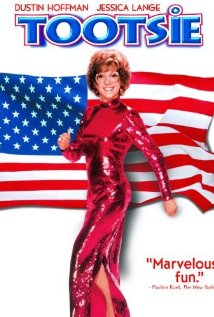
Tootsie: written by Larry Gelbart, Murray Schisgal, Don McGuire, Robert Garland, Barry Levinson, and Elaine May; directed by Sydney Pollack; starring Dustin Hoffman (Michael Dorsey/Dorothy Michaels), Jessica Lange (Julie), Teri Garr (Sandy), Dabney Coleman (Ron), Bill Murray (Jeff), Charles Durning (Les), George Gaynes (John Van Horn), Geena Davis (April) and Sidney Pollack (George Fields) (1982): Ah, what a great comedy. The cast is terrific and in fine form in this fable of an actor (Hoffman) who learns to be a better man by pretending to be a woman in order to get a job on a soap opera.

It's really remarkable how zingy the dialogue is throughout, and how uniformly excellent is the cast (including director Pollack as Hoffman's long-suffering agent). The difficulty of working with Hoffman forms a subtext to the entire picture -- Pollack refused to direct him again despite Tootsie's massive critical and commercial success. Bill Murray drifts in and out to provide a loose, improvisational Greek Chorus as Hoffman's playwright-room-mate, Jessica Lange won an Oscar for her sweet, funny performance, and everyone else is also awesome. Highly recommended.


The Mummy: written by Jimmy Sangster; directed by Terence Fisher; starring Peter Cushing (John Banning), Christopher Lee (Kharis the Mummy), and Yvonne Furneaux (Isobel/Ananka) (1959): Enjoyable, atmospheric remake by British Hammer Studios of the original 1930's Universal horror movie The Mummy. This movie completed Christopher Lee's Hammer trifecta of playing three of the four classic horror-movie monsters originally made famous by those Universal movies of the 1930's -- Dracula, Frankenstein's Monster, and the Mummy, but alas, no Wolf Man.

Lee hated the heavy make-up and costuming for the Mummy, and would avoid heavy make-up ever afterwards. Like Karloff before him, he towers over the rest of the cast (there's a funny moment in which a drunk English poacher claims that the Mummy is 10-feet tall, and it doesn't seem like that much of an exaggeration). Lee is again teamed with his Dracula and Frankenstein co-star Peter Cushing, here playing the son of the archaeologist who released the vengeful mummy into the world.

The Egyptian sets and costumes are really quite impressive, as are the moody scenes set on the moor and in the swamp nearby, with some nice staging for scenes in which the Mummy emerges from, and later descends into, the swamp. Cushing makes for an interesting hero here as he did in the Dracula films as Van Helsing, and Yvonne Furneaux is lovely in the dual role of Cushing's wife and the long-dead Egyptian priestess Ananka, whom Lee's high priest loved and was ultimately mummified alive for loving.

Lee does what he can with his eyes, the only expressive part his made-up face shows, and by the end achieves a sort of lurching, Frankensteinian pathos as the Mummy. That pathos is also partially obtained by having a cultist give the Mummy his murderous orders. The Mummy really looks like he'd rather not stir from his 4000-years' sleep. Recommended.