Showing posts with label hammer films. Show all posts

Wednesday, July 19, 2017

Five Million Years to Earth (1967)

Five Million Years to Earth (aka Quatermass and the Pit) (1967): written by Nigel Kneale, based on the BBC miniseries of the same name; directed by Roy Ward Baker; starring James Donald (Dr. Roney), Andrew Keir (Prof. Bernard Quatermass), Barbara Shelley (Barbara Judd),  and Julian Glover (Colonel Breen): British writer Nigel Kneale created three television serials for the BBC back in the 1950's featuring British rocket scientist Bernard Quatermass, a sort of proto-Doctor-Who figure, albeit a fallible, human one.

All three serials, along with a fourth starring John Mills in the early 1980's, pitted Quatermass and company against various alien invasions of the British Isles. This 1960's Hammer Film was based on the third Quatermass serial, Quatermass and the Pit, in which the excavation of a site in London, England for a new subway line uncovers strangely deformed ancient human skeletons and the remains of what appears to be an alien spaceship.

History reports that strange occurences plagued the site whenever digging or some other form of vibration took place over hundreds of years. And something does indeed seem to be waking up. Will the military and the government do something incredibly stupid, leaving the fate of the planet in the hands of Quatermass and his dedicated scientist friends? What do you think?

This is a very English science-fiction movie in many ways, not least of which is Kneale's WWII-enhanced concern with fascism at home and abroad -- and the fear that fascistic group-think can overcome anyone, no matter how intelligent or empathetic that person normally is. We're the Nazis now.

Five Million Years to Earth is a well-done movie, small of budget but big on ideas and weirdness. It's one of a relatively small number of old science fiction movies that could be improved with just a few minutes of good visual effects, as a key visual effects sequence has to be explained at length to the viewer for any sense to be made of it. However, there's also a truly disturbing visual effects shot towards the end that I don't think modern CGI could capture, simply because modern CGI tends to go for the overly detailed literal rather than the suggestively obscure. In any event, highly recommended.

Wednesday, February 24, 2016

The Devil's Bride (a.k.a. The Devil Rides Out) (1968)

The Devil's Bride (a.k.a. The Devil Rides Out): adapted by Richard Matheson from the Dennis Wheatley novel The Devil Rides Out; directed by Terence Fisher; starring Christopher Lee (Duc de Richleau), Charles Gray (Mocata), Nike Arrighi (Tanith), Leon Greene (Rex), and Patrick Mower (Simon) (1968): Fun, tightly plotted period piece (it's set in England in the 1920's) pits Christopher Lee in a rare heroic turn against the forces of Satan himself as conjured up by Aleister Crowley-esque black magician Mocata.

The great Richard Matheson does solid work turning a novel by the often clunky Dennis Wheatley into a crisply executed occult thriller that clocks in at barely 100 minutes. Lee commands the screen as a reluctant, learning-on-the-fly white magician who must battle the powerful Mocata (a terrifically oily, ingratiating Charles Gray) for the souls of two people who have been pulled into Satanic worship. 

The rites and spells sometimes sound so odd that you'd swear they were lifted from H.P. Lovecraft or William Hope Hodgson's Carnacki the Ghost-Finder series and not from actual occult sources. This Hammer film has a fairly low budget, as Hammer films always did, but the cinematography, direction, and set design mostly make up for it. There are a couple of goofy moments involving visual effects, but a couple of things also work quite well.

The film is at its creepiest when it keeps its demons off-stage, but that's true of virtually all horror movies. Wait for the moment in which a crucifix operates pretty much like the Holy Hand-grenade of Antioch. Reportedly this was Christopher Lee's favourite of his many Hammer Horror Films, partially because he himself suggested they make it and partially, I assume, because he got to be a commanding good guy for once. Recommended.

Wednesday, November 12, 2014

The Horror of Dracula (a.k.a. Dracula) (1958)

The Horror of Dracula (a.k.a. Dracula): adapted by Jimmy Sangster from the novel by Bram Stoker; directed by Terence Fisher; starring Peter Cushing  (Doctor Van Helsing), Christopher Lee (Count Dracula), Michael Gough (Arthur Holmwood), Melissa Stribling (Mina), Carol Marsh (Lucy), John Van Eyssen (Jonathan Harker), and Olga Dickie (Gerda) (1958): Deft hyper-condensation of Bram Stoker's classic vampire novel introduced the horrors of England's Hammer Studios to the world -- along with actors Christopher Lee and Peter Cushing. Their appearances in Star Wars and (for Lee alone) the Lord of the Rings movies can be traced directly to their beloved work in movies such as Horror of Dracula.

Or just Dracula. Hammer changed the title for the 1958 American release because the Bela Lugosi 1930's Dracula still made the rounds of movie theatres at the time, though it would soon be sold in a package to television and mostly vanish from conventional theatre chains.

Did Stanley Kubrick watch a lot of Hammer horror movies? Because Horror of Dracula is a horror movie with very little darkness in its scenes of horror -- instead, we've got colourful sets and colourful cinematography that anticipate The Shining's super-saturated palette. Castle Dracula is very brightly lit. Especially given that it's 1888.

I'll leave a dissection of alterations to the original text to the viewer. They mostly work. And they're pretty necessary, given that the market of the late 1950's pretty much required that Horror of Dracula clock in at 90 minutes or less. So the movie hits the ground running.

Lee is terrific as Dracula, far and away his defining genre role (sorry, Count Dooku and Saruman). The film-makers use his height to good effect. Smooth and charming in the opening scenes set at Castle Dracula, Lee's Dracula becomes a mute monster once the action shifts to nemesis Van Helsing's home-town. Once Dracula's status as a vampire has been confirmed, he no longer has the need for social niceties. Or dialogue.

Peter Cushing is also terrific as vampire-fighter Van Helsing, investing this version of the character with a sort of Holmesian stature. His final battle with the bloody Count now seems iconic and much-imitated. A young Michael Gough does solid work as Arthur Holmwood, and Melissa Stribling is suitably conflicted as Dracula's final object of exsanguination, Mina. Terence Fisher keeps things moving at a rapid pace. Probably the best official adaptation of Stoker's novel, for all its changes to the text. Did I mention it's 82 minutes long? Highly recommended.

Saturday, August 3, 2013

Imitations of Life

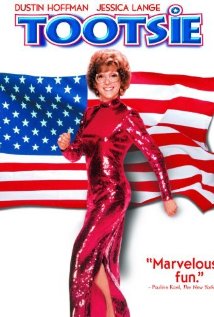
Tootsie: written by Larry Gelbart, Murray Schisgal, Don McGuire, Robert Garland, Barry Levinson, and Elaine May; directed by Sydney Pollack; starring Dustin Hoffman (Michael Dorsey/Dorothy Michaels), Jessica Lange (Julie), Teri Garr (Sandy), Dabney Coleman (Ron), Bill Murray (Jeff), Charles Durning (Les), George Gaynes (John Van Horn), Geena Davis (April) and Sidney Pollack (George Fields) (1982): Ah, what a great comedy. The cast is terrific and in fine form in this fable of an actor (Hoffman) who learns to be a better man by pretending to be a woman in order to get a job on a soap opera.

It's really remarkable how zingy the dialogue is throughout, and how uniformly excellent is the cast (including director Pollack as Hoffman's long-suffering agent). The difficulty of working with Hoffman forms a subtext to the entire picture -- Pollack refused to direct him again despite Tootsie's massive critical and commercial success. Bill Murray drifts in and out to provide a loose, improvisational Greek Chorus as Hoffman's playwright-room-mate, Jessica Lange won an Oscar for her sweet, funny performance, and everyone else is also awesome. Highly recommended.


The Mummy: written by Jimmy Sangster; directed by Terence Fisher; starring Peter Cushing (John Banning), Christopher Lee (Kharis the Mummy), and Yvonne Furneaux (Isobel/Ananka) (1959): Enjoyable, atmospheric remake by British Hammer Studios of the original 1930's Universal horror movie The Mummy. This movie completed Christopher Lee's Hammer trifecta of playing three of the four classic horror-movie monsters originally made famous by those Universal movies of the 1930's -- Dracula, Frankenstein's Monster, and the Mummy, but alas, no Wolf Man.

Lee hated the heavy make-up and costuming for the Mummy, and would avoid heavy make-up ever afterwards. Like Karloff before him, he towers over the rest of the cast (there's a funny moment in which a drunk English poacher claims that the Mummy is 10-feet tall, and it doesn't seem like that much of an exaggeration). Lee is again teamed with his Dracula and Frankenstein co-star Peter Cushing, here playing the son of the archaeologist who released the vengeful mummy into the world.

The Egyptian sets and costumes are really quite impressive, as are the moody scenes set on the moor and in the swamp nearby, with some nice staging for scenes in which the Mummy emerges from, and later descends into, the swamp. Cushing makes for an interesting hero here as he did in the Dracula films as Van Helsing, and Yvonne Furneaux is lovely in the dual role of Cushing's wife and the long-dead Egyptian priestess Ananka, whom Lee's high priest loved and was ultimately mummified alive for loving.

Lee does what he can with his eyes, the only expressive part his made-up face shows, and by the end achieves a sort of lurching, Frankensteinian pathos as the Mummy. That pathos is also partially obtained by having a cultist give the Mummy his murderous orders. The Mummy really looks like he'd rather not stir from his 4000-years' sleep. Recommended.

Wednesday, July 31, 2013

Sleepy Hollow (1999)

Sleepy Hollow  (1999): adapted by Kevin Yagher and Andrew Kevin Walker from the Washington Irving short story; directed by Tim Burton; starring Johnny Depp (Ichabod Crane), Christina Ricci (Katrina), Miranda Richardson (Lady Van Tassel), and Christopher Walken (The Horseman): 

Tim Burton's homage to the Hammer horror films of the 1950's and 1960's looks terrific -- it's a triumph of muted cinematography, if nothing else. And after another 13 years of macho heroes, Johnny Depp's perennially frightened Ichabod Crane seems a lot more palatable than he did in 1999. He's another twitchy Depp freakshow, but he's at least plausibly freaky and refreshingly low on testosterone.

The film turns the old Washington Irving tale into a somewhat creaky supernatural detective story without much mystery -- you may figure out who's behind everything in the first 15 minutes or so. And that's OK. It's really a movie about fog and darkness and creepy things.

Burton, as usual, goes too far at a couple of points with the visual effects. An homage to his own Beetlejuice is especially annoying. And the McGuffin is almost laughably banal. However, the cast is terrific, and Christina Ricci is both lovely and, as a heroine, has actual important things to do other than screaming. Recommended.


Monday, November 12, 2012

Screaming and Eels

The Woman in Black: adapted by Jane Goldman from the 1983 novel by Susan Hill; directed by James Watkins; starring Daniel Radcliffe (Arthur Kipps) and Ciaran Hinds (Daily) (2012): By all rights, this should be a movie about a young, early-20th-century British solicitor who travels to a small English sea-side town only to discover the town deserted, the residents all having moved to the United States, or perhaps even the Moon.

Given what's going on in the gloomy English east-coast town of Crythin Gifford, nobody would continue to live there. I don't care how good the fishing is. So one has to take this improbability and run with it, as one sometimes must when the devil vomits into one's tea-kettle.

Set just prior to World War One, The Woman in Black follows Daniel Radcliffe as that young solicitor, a widower whose wife died giving birth to their now-4-year-old son. Radcliffe isn't done any services by the early part of the film, during which he plays chronic grief as if it were chronic constipation.

He gets better as he's allowed to emote more, though he never seems to emote quite enough under the circumstances, which involve an isolated, supremely creepy mansion; children who keep committing "suicide" by jumping out windows, drinking lye, or lighting themselves on fire; a serial-child-killing ghost who enjoys screaming and sudden bursts of quick movement; a room full of creepy toys and an extremely disturbing rocking chair; and the tormented and occasionally screaming ghosts of dozens of dead children.

Both the movie and the novel it's based on are homages to something more literary than filmic -- the classic British ghost story as practiced by writers that include J. Sheridan Le Fanu and M.R. James. The mansion is the scariest character here, a marvel of set design, with the ghosts and the mise-en-scene coming a close second: a lot of the scares in the movie rely on something somewhat indistinct edging into the background before becoming more distinct and/or getting closer and closer...

Ciaran Hinds really has the only other role in this movie with any substantial lines, as a resident of the town who's been touched by tragedy but persists in not believing in ghosts. Also, he has a motor car that comes in handy towards the end. But would anyone be surprised that a place named Eel Marsh House is a bad place? Anyone? Recommended.